2026 TYMRC Workshop Summary
Workshop on Large Language Models and Optimization
From February 2 to 6, 2026, the Workshop on Large Language Models and Optimization was successfully held at the Tianyuan Mathematics Research Center (TYMRC), Kunming. The workshop brought together experts and early-career researchers in optimization and machine learning from China and abroad. Centered on key themes including optimization theory, optimization algorithms, large language models, and artificial intelligence, the event focused on the deep integration of foundation models with mathematical optimization. Its goal was to build a high-level academic exchange platform and promote a shift in optimization research from isolated methodological advances to full-pipeline innovation across modeling, solving, proving, and automation.
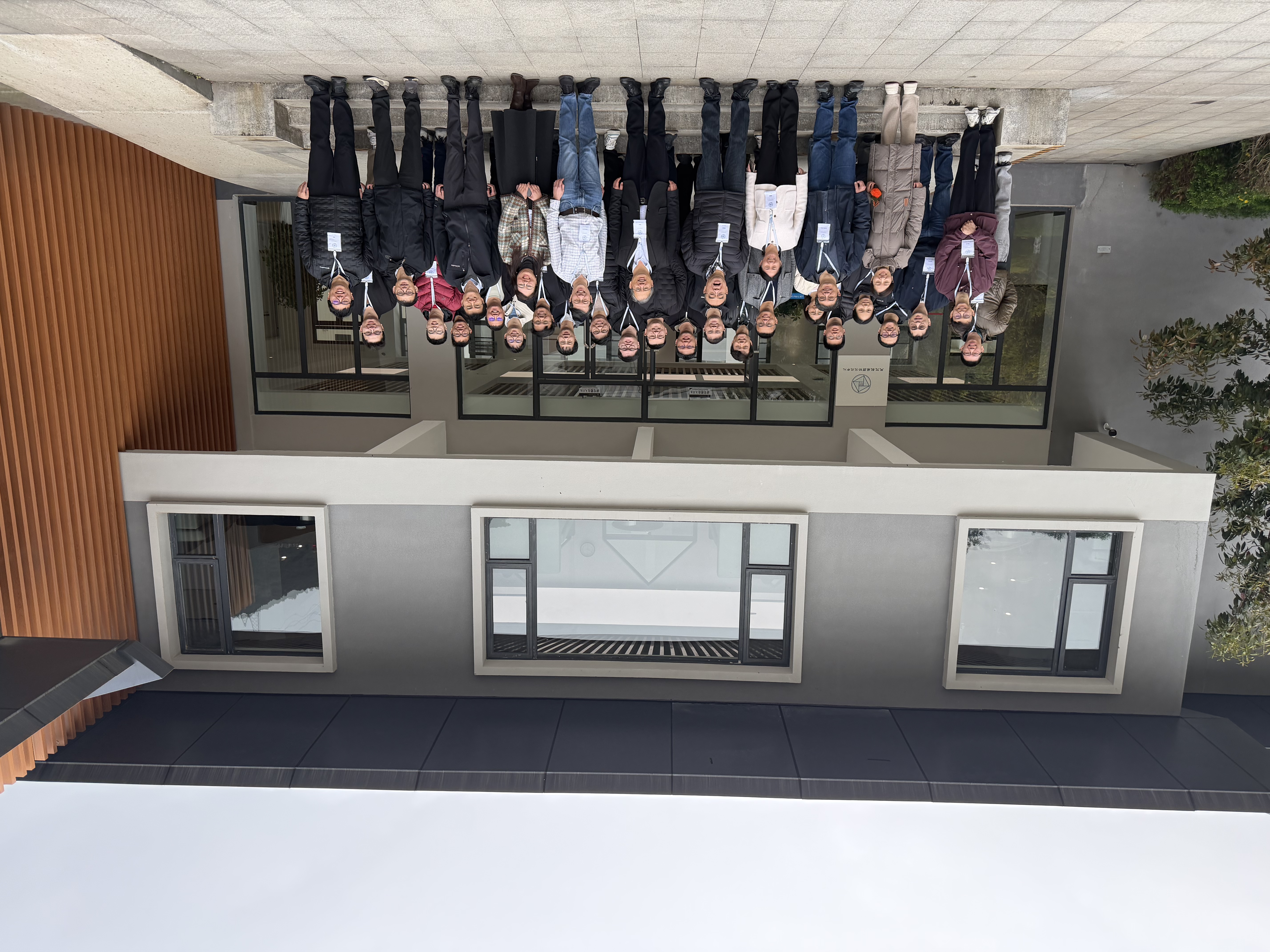
Expert Talks and Academic Discussions
The workshop featured multiple high-quality invited talks on frontier topics in large models and optimization, covering optimization theory, algorithm design, computational methods, and optimization problems arising in the era of large models. The opening session was chaired by Prof. Deren Han, who delivered opening remarks. Prof. Wenzao Su discussed stationarity characterizations and computational boundaries for optimistic value functions in bilevel optimization, emphasizing implementable algorithmic criteria under set-valued lower-level solution mappings. Prof. Zizhuo Wang presented training frameworks for large models in optimization modeling, highlighting data construction, inference strategies, and reinforcement learning for improved modeling capability.Prof. Kun Yuan analyzed memory bottlenecks in large-model training from a stochastic optimization perspective and introduced subspace optimization ideas that balance efficiency, stability, and resource constraints. Prof. Deren Han further reported tighter error bounds and inexact criteria for absolute value equations and related nonsmooth problems, strengthening robustness-oriented algorithmic analysis. Prof. Liwei Zhang presented Halpern acceleration for inexact proximal-point methods and its extension to augmented Lagrangian frameworks, showing improved convergence and efficiency under controllable inexactness. Prof. Qing Ling addressed structural distortion and data constraints in AI weather forecasting, demonstrating optimization pathways that combine physical priors with topology-aware modeling. Prof. Songtao Lu reported algorithmic frameworks and complexity analysis for bilevel optimization with game-theoretic and multi-objective lower-level structures. Prof. Yancheng Yuan introduced a perturbed DCA method for computing d-stationary points in nonsmooth DC programming, achieving a better balance between theoretical convergence and computational efficiency. Prof. Kuang Bai focused on directional necessary optimality conditions for bilevel programming and established a more verifiable analysis framework under graph constraints and directional constraint qualifications.
Overall, these talks jointly highlighted a clear trend toward coordinated advancement across optimality theory, algorithm design, and system implementation, demonstrating how optimization research is moving toward full-process intelligence in the age of large models.
Schedule and Academic Exchange
The workshop followed a compact and well-structured agenda over five days, organized in a hybrid format of thematic talks + open exchange. In addition to scheduled talks, focused discussion sessions and post-session exchanges were arranged to facilitate in-depth dialogue across research directions.
In terms of content progression, the early stage of the program focused on new opportunities brought by large-model-driven optimization, including natural-language-to-optimization modeling, training-oriented optimization methods, and resource-efficient learning. The later stage moved to specific optimization problems and theoretical methods, including bilevel optimization, nonsmooth and DC optimization, proximal and operator-splitting methods, and optimality/error analysis under complex constraints. The workshop also emphasized practical deployment in scientific computing and intelligent systems, such as distributed optimization and physics-informed modeling.
Discussions around the representative talks converged on three major lines:
1.Theoretical analysis centered on stationarity, directional conditions, and computability;
2.Algorithmic research centered on acceleration, inexact criteria, and complexity bounds;
3.Cross-disciplinary practice centered on large-model training, task-oriented modeling, and application systems.
Through Q&A and open discussion, participants exchanged views on key assumptions, methodological boundaries, reproducibility, and potential collaboration, producing strong cross-directional complementarity. Overall, the schedule successfully balanced frontier depth and structural coherence, laying a solid foundation for future joint research and sustained exchange.
Summary and Outlook
The workshop enabled systematic exchange on optimization theory, algorithm design, and large-model methodologies. Participants widely agreed that the meeting was focused, substantial, and discussion-intensive, providing both a clear picture of frontier progress and a concrete framework for future collaboration.
Three layers of consensus emerged:
Theory: key issues in bilevel optimization, nonsmooth/nonconvex optimization, directional optimality conditions, and computability boundaries were further clarified.
Algorithms: exchanges on proximal/operator-splitting acceleration, inexact criteria, complexity analysis, and training-time optimization reinforced a dual emphasis on provability and implementability.
Applications: reports on large-model-based modeling, distributed optimization, and scientific computing showcased practical value and expansion potential in complex systems.
The workshop also promoted substantive cross-field dialogue. Optimization theorists and large-model researchers moved toward stronger common ground on abstraction, assumptions, and evaluation protocols, while young researchers gained clearer entry points through focused sessions and open exchange. Collectively, the event strengthened full-process linkage across modeling, solving, analysis, and validation, indicating a transition from isolated advances to systematic co-development.
Looking ahead, participants suggested prioritizing: (i) stronger theoretical foundations for optimization–LLM integration, especially verifiability and convergence analysis; (ii) unified datasets, benchmark tasks, and open-source toolchains for reproducibility and comparability; (iii) prototype validation of multi-agent collaborative optimization and automated workflows from requirement interpretation to model generation, solving, and explanation; and (iv) deeper academia–industry collaboration to accelerate real-world deployment and iterative improvement. With continued effort, this area is expected to develop into a sustainable innovation ecosystem with both theoretical depth and practical impact.
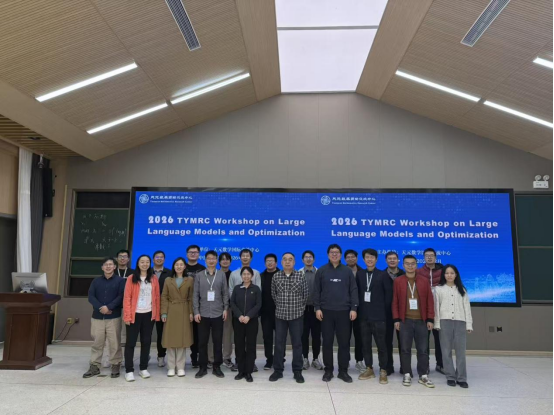
Acknowledgements
The successful organization of this workshop was made possible by strong support and close collaboration from all parties. We sincerely thank the TYMRC for hosting and overall coordination; the organizing committee and coordinators for their extensive efforts in program planning, speaker invitation, and conference logistics; all invited speakers and participants for active engagement and insightful discussion; and the TYMRC staff for meticulous support in venue operations, technical services, and administrative arrangements. Their collective contributions ensured a high-quality and highly productive workshop.